Wednesday, March 2, 2011

Backcountry Navigation

Seeing recent news articles and forum discussions about people getting lost in the backcountry while relying solely on GPS reminded that this subject needs to be covered here. The more recent incidents, taglined as “Death by GPS” involve a fatality and near fatalities. That is what we obviously need to avoid. Getting lost, even as a minor inconvenience, can disrupt your plans for the day as you spend time to find your way again. As a root cause of the more serious examples it appears there is not enough attention focused on where they were and where they were going. This blog will not address backcountry travel beyond finding your way. That is another whole subject that I’ll cover at a later date.

Fortunately I am one of those people that have a good sense of where I’m at, geographically. That is probably because I get real uncomfortable if I don’t know where I am. Being good with maps or geographically astute doesn’t hurt either. However, even more so with today’s technology, anyone can be a good navigator. Like anything else it simply has to be learned. As a small child I enjoyed being navigator while my dad drove on our many trips together. As a boy scout I learned to use a map and compass in the field. And many years of sailing and offshore navigation have only reinforced the basic tenants of good navigation. The recent development of GPS has been a great advantage, although it must be stressed to know the basics.

You should know how to read a map. If not just Google “map reading”. Get comfortable with your map reading skills to the point that you feel you can rely on those skills. Use a map even when you don’t really need one. Look at it while traveling familiar roads. Trust me you’ll learn something you didn’t know before. I’ve done this since my days traveling with my dad and it has developed my geographical knowledge.


First get prepared. You will want to build an inventory of navigation aids. Things like maps, compass, GPS and travel guides. Start with good maps. You’ll need several. The first and foremost rule of good navigation is to never rely on only one source of information. Why several maps? Well first of all, scale. You should have a single map that covers your entire route; this at least for planning purposes or unexpected detours. Detailed map(s) for the specific area you’ll be in. I’ve found two good maps of the same area can represent a different picture or be interpreted differently (i.e. one may show a road or trail, the other may not).

I’ve spent many years collecting maps and charts of all types. AAA has been known for years for their cartography. I’ve found their county maps to be very good. They are clear, easy to read and show most roads you could travel on as you get away from populated areas. The DeLorme state atlases are very good too. There are many excellent specialty maps like Tom Harrison’s or maps published for a particular recreation area or state or national park. The US Forest Service has maps for every national forest. I have many of these maps. Bureau of Land Management, BLM, has equivalent maps for other areas. These are also good to obtain. Of course USGS has topographical maps down to the 7.5 minute “quads” showing every detail be it spring, mine, creek, canyon, trail, road, outbuilding, whatever. These are generally used by hikers but I sometimes use them on 4 wheel drive trips if I’m looking for a particular geographic feature.

Travel guides are also good for information. There are several out there for backroads and 4WD trails, etc. They can give insight that may not be found on a map and could make your trip more enjoyable. It is worthwhile to state the importance of knowing the nature of the route you are going to travel. Is it paved, gravel, dirt, badly rutted or washboarded? Is it rated for high clearance 2WD vehicles? I’ve traveled some that are noted for “experienced 4WD drivers only”. 


You will want to plan your trip. This does not mean you need to develop and follow a rigid itinerary. You can plan to just wander around. Just consider the entire range of your wandering. This will allow you to collect and study the maps, guides or trail reports for your trip. Always let someone back home know at least roughly were you plan to be and for how long. Call the local Ranger or authority ahead of time. They are more than happy to give you information on a particular road including up to date weather conditions. Some roads are closed in wet weather. One of the very few times I didn’t call ahead we arrived to find the entire area we planned on jeeping for the weekend was closed for restoration after a forest fire. Good planning simply helps to eliminate variables and makes the trip more enjoyable.

 Somewhat off topic, calculate your fuel range and should that be an issue keep a mileage log and always know how far you can get with the fuel you have. I bring this up as in most of the longer trips I take in the Southwestern deserts require side trips for fuel (and I carry 2 jerry cans). In fact I always track my fuel consumption in my jeep. You could be very surprised to find that your mileage with aired-down tires, transfer case in low range in deep sand or rough low gear terrain is only a fraction of what you thought. I route plan so that I can gas up without every using that last jerry can of fuel. That is the reserve fuel for the unexpected detours because of washouts or whatever changes come your way.

I’ve found good up to date information on the internet (usual precautions apply) at several forums. In planning routes to places I’ve never been to Google maps in satellite mode or Google earth are good for seeing the terrain. Maps do not necessarily show every road or trail that aerial photography does. I have used this method to find primitive campsites were I’m planning to meet others that are arriving later. I just tell them I’ll be camping at such ‘n such coordinates.

Another navigation method involves time and distance. Sailors have used “dead reckoning” for hundreds of years. Simply put, if the dirt road between the highway and your destination is 20 miles and you’ve been averaging 15 miles per hour and driving for an hour are your there yet? No, you’ve got another five miles to go. Remember use as many different sources of information as you can. This can be over simplified but it is common to find there are many more “roads” than the map indicates. If they are not signed you could make a wrong turn. Use a small note pad to log your time and odometer at each point such as changing roads or a know point that is signed. I use a dry erase marker and log it on the inside of my windshield.

Most of these methods have worked for many people for a long time before the advent of GPS. Unfortunately some people without experience in backcountry travel depend upon a GPS as the sole source of information. This is simply asking for trouble once you’re off the beaten path.

Most of the places I camp and explore in are just a big blank on a typical GPS screen. That is why you need the other sources of information. The GPS screen may be blank but outside isn’t. So I just drove across a small bridge, there’s a mountain on the left and a bigger one on the right, just a little further ahead. I look at my map at where I think I should be. I see the map indicates there’s a bridge and some mountains to the left and bigger ones further to the right. I check the time and based on my average speed I am reasonably confident I know where I am. And I see a few miles further there is some definite landmark to further confirm my location. Life is good.

There are some GPS units designed with back country travel in mind. These have topographical maps that show physical features like streams, contour lines and dirt roads and trails. Most of these are small handheld units. Practice reading the degree coordinates (or UTM) off you GPS and finding that point on your map. In my jeep I use a Lowrance Baja540c. It has a larger than typical screen. When I bought it was the only one with off-road map software. It also allows me to open the map on my PC, customize it with waypoints and routes and such, save it to the memory card and load into the unit in the jeep. It also simplifies my logs as it does track distant, elapsed time and things like that. But I still keep my written logs.


So remember to use as many sources of information as you can get for comparison. Each additional source increases your degree of accuracy and reduces you degree of error. Learn your route ahead of time. Practice these methods even on your easy well signed trips. Eventually you’ll be able to do all this as second nature. Then you’ll be free to enjoy the outdoors with the peace of mind that you know where you are and know where you’re going, geographically that is.

Saturday, November 27, 2010

A Good Night Sleep


Over the years I’ve had my share of restless nights trying to sleep in the outdoors. With the topic of shelter aside (I’ll talk about shelter another time) there are few other factors to influence your nights slumber than what’s under your sleeping bag.

Some of it may be a factor of age. As a young teenager backpacking in the Sierra Nevada I could get a good night sleep with my bag directly on a granite slab. These days most everything feels like that granite slab in the wee hours of the night. I’ve gone through a number of mattresses, pads and whatever over the years.

The air mattress. I’ve noticed a lot of newer campers use these. I think that is simply because that’s what they sell in the department store camping section. Remember, just because they sell that doesn’t mean you need it. When the rechargeable inflation pumps became available a few years back my friend  recommended I try it. So I bought the kit. They are OK. I’m not real fond of the rolly-polly feel. It does take up a lot of room in my small 2 man tent I use for light trips. Then it sprung a leak. I awoke in the middle of the night with memories of cold hard granite. Not good. When I got home I repaired the leak. Then I made the mistake of taking it on my next trip. It was fall and we were at higher altitude. It got down to 26 degrees at night. Waking up at night with my bottom side very cold and my top side nice and warm I quickly blamed myself for not knowing better. That big mass of air in the mattress simply got cold during the course of the night. Yet another restless night.

The cot. Good for the longer trip when you’re taking lots of gear. But they are too bulky for the light trip. A couple of things I’ve learned. Get the right size. Cot frames differ. Some styles only have frame members down the sides. Others have a frame all the way around. If your feet and head are touching the frame it will bother you during the night. If its narrow and you like to spread out like I do the side rails can be uncomfortable. You could get one that’s plenty big but you could find that it takes up too much room. My good friend brought one on a trip one winter. Being a base camp, cold weather trip we figured we’d live large. Brought my six man, four season tent. His cot practically covered all the real estate inside. When he sat on it his feet didn’t even touch the ground. I told him it was big enough to conduct aircraft operations on. After our trip he returned the “aircraft carrier” for a smaller version.

If the weather is cold (or could get cold) you will need some insulation under your sleeping bag. Even with the best cold weather bags the pressure points were your body presses down will compact the insulation to near nothing. You will soon feel all that cold air under your cot. Use a high density foam pad like I do. Even a blanket or cheap/old sleeping bag would help. The less it compresses the better insulator.

Foam pads. I’ve got several of these and have used then for many, many years. There are several types and there is one that would match your personal preferences. They are great for backpacking or light car trips. Well, any camping trip for that matter. They perform relatively the same year-round. They don’t leak, they are inherently good insulators and are very, very durable. Do your research and try them out for size. There are variations for any type of camping and they run the scale as far as pricing. They make a good choice for a good night sleep. 

Hybrid foam pads. No these don’t have anything to do with fuel economy! These are the next level of the good ‘ol foam pad. General known as self-inflating sleeping pads or mattresses. They are foam with a tough, durable and air-tight outer layer. The pad is unrolled and allowed to “breath in” for several minutes. It expands into a thicker more comfortable pad than the regular foam pad. I even give it a few puffs to firm it up some more before closing the valve. When breaking camp the air is pushed out by rolling it up then closing the valve. This compressed package saves storage space.  I’ve never had “contact” with the ground with this pad. 

The one I use is a Therm-a-Rest Luxury Camp. They even make one that is really comfortable. I’ve had it for about six or seven years and I love it. It is what I reach for when I’m packing. It has never let me down (no pun intended). I’ll admit it is not cheap. Shop around. Find a store where you can try it out. They come in various sizes too. I kinda felt I was splurging when I bought mine. Not now. Worth every cent I paid.


Campsite Lighting


Use a lantern.
Simple solution.
How about using a good lantern. Even better.

So just what makes a good lantern? I can still remember camping with my family as a young boy. Pouring (and spilling) the white gas into the old green lantern. Then pumping the tank till my arm was tired. Watching my dad trying to light it while my mom insisted I was too close should it explode. A Good memory but maybe not a good lantern. Actually I still have that old lantern up in the rafters.

Propane has been a big improvement in lanterns. Clean, no spills, reasonably safe. I’ve got several of them. I don’t think any of them are good. One has no fine adjustment for intensity. It’s either blinding bright or practically off. The one that has a nice fine adjustment squeals like a steam boiler about to bust its rivets. Always have to remember to have extra mantles. Because the ones on the lantern don’t fare well on a rough jeep trail. My fat old fingers aren’t as deft as they used to be when tying them on. Don’t even bother with those “clip-on” type mantles. Then there is the broken glass. When I broke the glass on my favorite propane lantern I bought some fine stainless steel mesh and fabricated a replacement. Works great!

My propane lanterns and propane stoves share the same drawback. Those little green, overpriced, always goes empty before the coffee pot comes to a boil propane fuel canisters. More than once I thought I had packed several only to learn I’d be eating cold food and not have coffee in the morning. (Some parts of the desert southwest do not have enough downwood to build a cooking fire). Bought a small 2 gal propane tank that holds enough for a good week. Great for the long weekend trips when there are a bunch of us. But I find it is too big for solo trips in the jeep. Granted with the “hose tree” it will run both the stove and lantern. But that whole ensemble takes up a lot of precious space in an old Jeep.

I have an electric lantern. An older one with big batteries and an incandescent bulb. It has no soul. It gives off a weak, cold glow. Barely useful, except inside the tent, like when my son is camping with me. Now LED lights are great. They use far less current than incandescent bulbs so your battery lasts longer. But I don’t like them for lanterns. However they are great for flashlights. Best flashlight I’ve ever had is a tiny little Sure-Fire.
When I was going through the “bring it all” phase of camping I used a voltage inverter to power a 2 foot fluorescent lamp hung under the 10’X10’ “kitchen” canopy and a few compact fluorescent fixtures elsewhere. Worked great, lots of light for the entire compound. The passing airliners could probably see us!

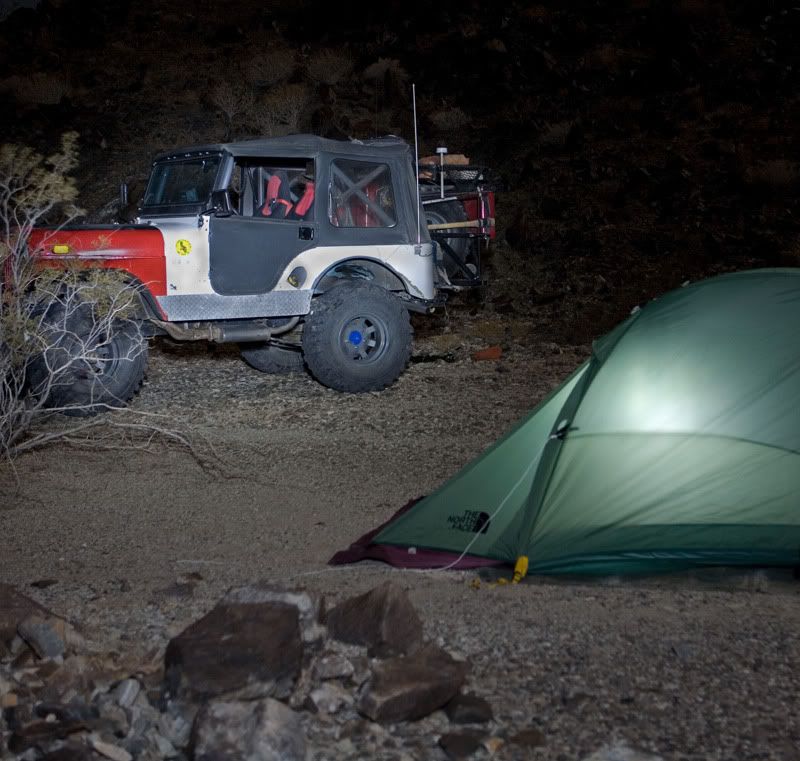
Last winter I spent 5 days driving solo in the Sonora Desert in my Jeep. I intentionally left the lantern at home. I brought my little Sure-Fire flashlight and an old mini-mag AA flashlight with red filter over the lens. I never really used either of them. Simply didn’t turn them on. I’d get my dinner prepared before it got really dark. Without the flashlights or lanterns to contract my pupils I didn’t need them. There was less than half a moon and even when it set the starlight alone was enough to see. It’s a very enjoyable time to take a hike. Of course with a full moon and eyes adjusted for at least 30 minutes one could easily read the a newspaper by moonlight. When sailing offshore at night it is the rule. No lights on deck and only red light below deck.

I now regularly practice the low-light campsite routine and find the outdoor experience to be much more enjoyable. It is far different than a bright well lit campsite where you can’t see anything but darkness beyond the lanterns cast.

So…. campsite lighting? Forget the lantern, use your eyes. A simpler solution


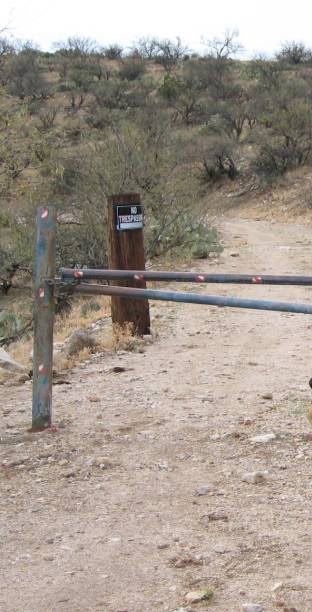
Access to Our Public Lands


Well I might as well go ahead and get it out there. Yea, it’s a real hot button issue for some. But then some people will always have issues.

I am a firm believer in preservation. Although creating a wilderness area only limits the access to a very few. The remainder will never see it. Then after a generation or so it will be forgotten, even fewer will care about its importance. And that will be the next step in losing it all forever, apathy.
 
Now based on the fact that I often travel in the backcountry in a jeep, people might identify me as an off-roader. I try to disassociate myself from the bulk of that group as many are a bad example of how to use, and keep using, our public lands. It’s not a case of loving it to death but simple, self-centered ignorance. I always practice ideals like “tread lightly” and “leave no trace”.

So you’ve probably figured out by now that I’m not a zealot. Just a middle of the road guy…. a regular Joe. But I think there are many of you out there like me. You love to spend your free time outdoors. You want to maintain that freedom. You want to be a good steward of our public lands. And maybe along the way you just might enlighten some others to your viewpoint.

Welcome


I hope you find your visit here worth your time. I was inspired to create this site by a friend new to camping. While discussing, around a campfire of course, places to go camping we agreed that there is not much of value available on the internet. Not to say there aren’t some good sites. Actually some very good sites exist.

This site is intended to be about the whole outdoor experience. It is of course slanted towards my preferences. However, it is my intent that everyone should find something of value here.
So…. what are my preferences? I avoid National Parks. They are beautiful places but way too many people for me. As for regular campgrounds, I detest having to make reservations or show up days early to get a decent campsite. Then only to have some gigantic RV run a generator around the clock.

So where does that leave me? Why in some of the best spots there are. Some will disagree for many reasons. That’s OK…. It’s just not me. I’ve tried everything from backpacking (still enjoy it on occasion) to RVing. I have found myself searching for that perfect balance. If you prefer to drive to your destination, camp in reasonable comfort and privacy and truly enjoy the outdoors then you’re like me.

So place you chair around the campfire, grab your favorite beverage and let’s talk about getting out and enjoying our great outdoors.